Optimise your routes before the van leaves the warehouse.
Rowan Tech's TMS for companies with their own fleet: distributors, local couriers, technical services. It calculates the optimal road route based on capacity, time windows and the real €/km of each vehicle, and gives the driver an app with navigation, digital signature and automatic return of the delivery note to your ERP.
Base product already built. Every implementation is personalised to your company's system, fleet and operational rules.
The process, step by step

The TMS for companies with their own fleet. Doesn't matter if it's 2 vans or 300.
A TMS (Transportation Management System) is the software that decides which delivery goes to which customer, in which vehicle, in what order and at what time. Rowan Rutas works from two vehicles upward. From there it scales with no ceiling: the same product serves a bakery with two vans delivering around its city and a distributor with eighty vehicles across several provinces. What changes from one case to another is the integration with your system and the operational rules — the optimisation engine is the same, and it always calculates real road routes, not straight lines on a map.
The product is made up of three pieces: a mobile app for drivers, a web dashboard for whoever plans from the office, and an API that connects to your ERP or your spreadsheet. All three are delivered with your brand, integrated with the system you already use.
What comes out of the box.
Operational functionality ready from day one. It isn't designed for your client, it's connected to your client.
Multi-vehicle route optimisation
Algorithm that assigns stops to vehicles by capacity, zone, time window and the real €/km of each plate.
Mobile app for drivers
List of stops, turn-by-turn road navigation, customer signature, delivery-note photos and automatic notification to the ERP.
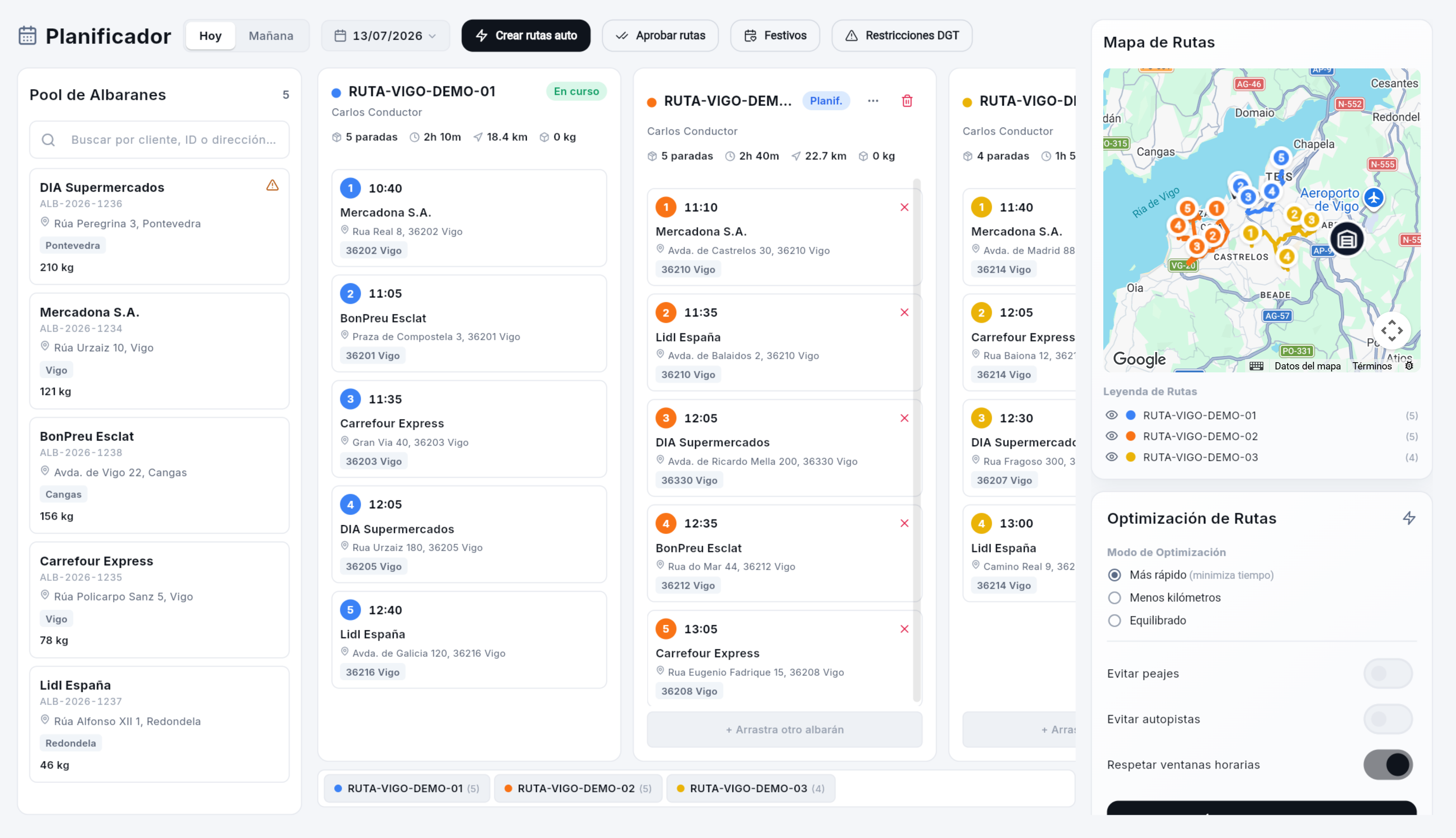
Planner dashboard
Map view with all of the day's routes, drag & drop between vehicles, live recalculation when an urgent order comes in.
Per-vehicle cost model
Define the real €/km of each vehicle in your fleet. Optimisation chooses by cost, not just distance.
Fleet history and analytics
Km per vehicle, average time per stop, stops/day, % compliance with time windows and deviation against plan.
Optional ERP connector
Order import and return of signed delivery notes. Compatible with Holded, Sage, Odoo, Rowan ERP or any REST API.
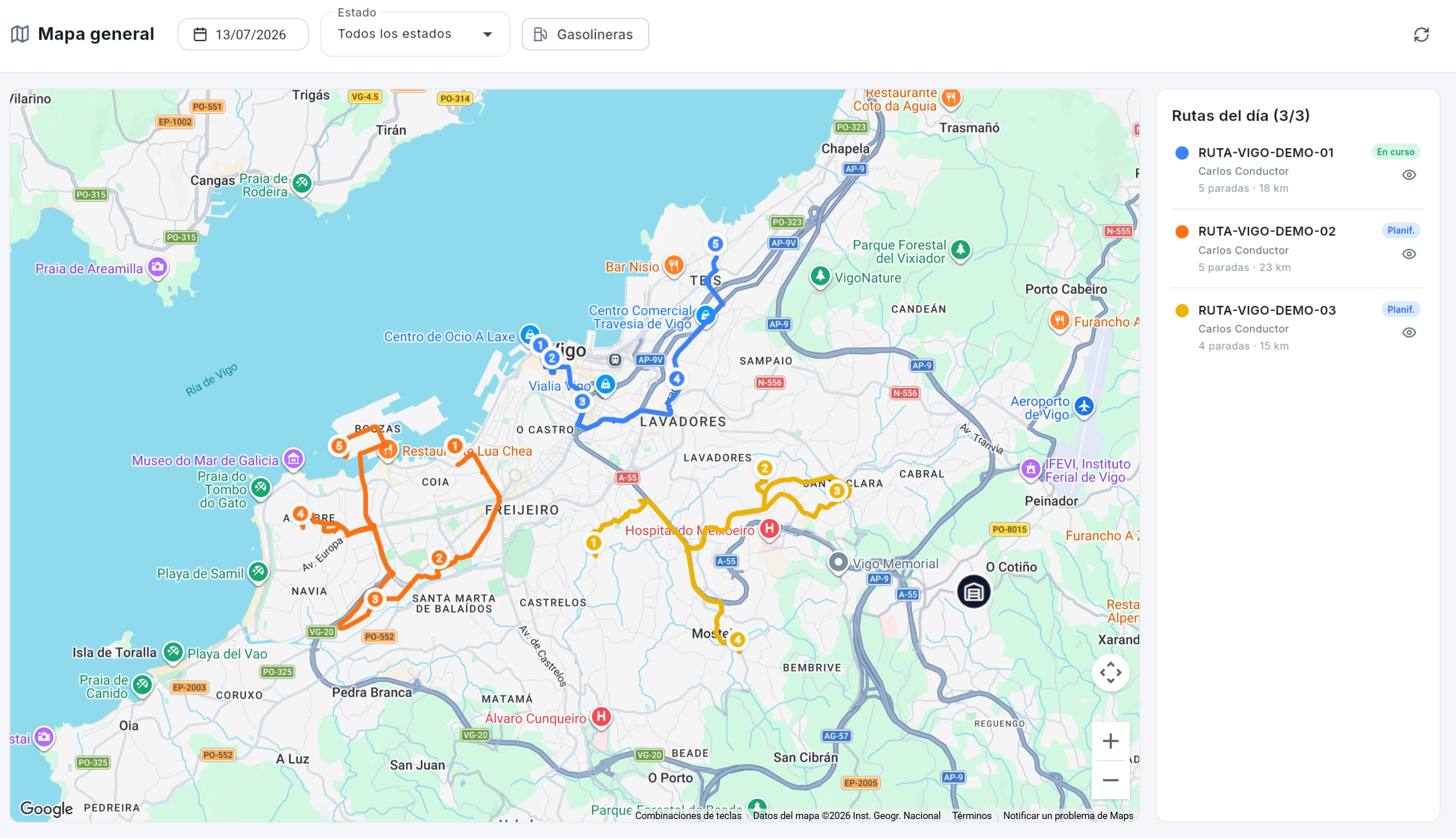
The day's routes, on the real map.
Every route of the day with its driver and stops, drawn along real roads — not straight lines — on the map. Filter by status, switch day and follow the operation at a glance.
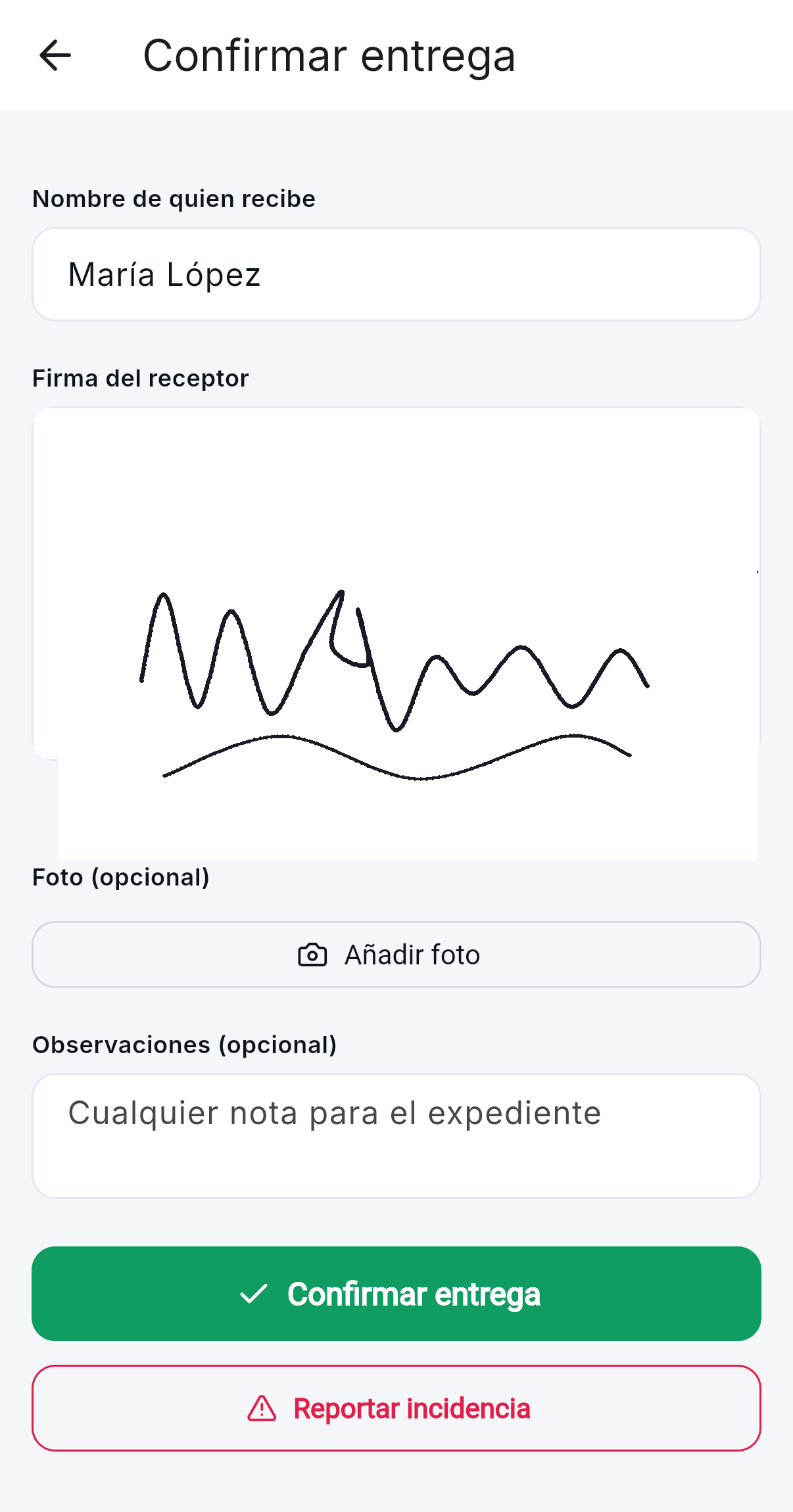
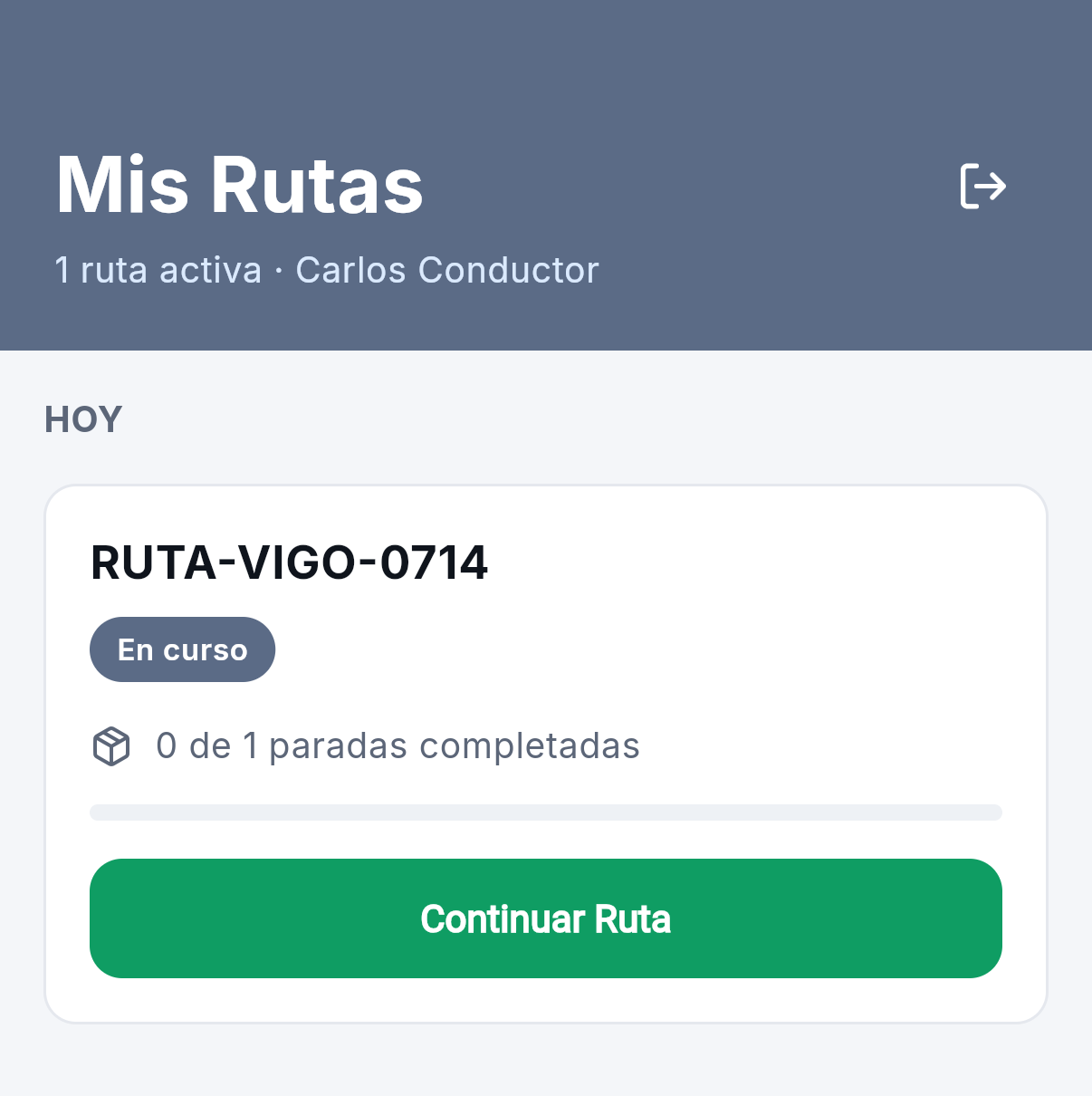
Navigate, deliver and sign paper-free.
The driver sees their optimised route stop by stop, navigates with a tap and captures the customer's signature on delivery. Status returns to the office in real time, with no phone calls or paper logs.
Optimal routes before you leave the warehouse
Plan by capacity, time windows and real cost per vehicle. Your driver gets navigation, digital signature and delivery notes sent straight back to the ERP.
Fewer kilometres, zero paper, total visibility.
No two implementations are ever the same.
A drinks distributor with 12 vans and bar time windows doesn't have the same operation as a boiler maintenance service with 4 technicians and pre-agreed appointments. Rowan Rutas starts from the same engine but adapts the data connection, the rules and the real cost to each client's model.
Way of working: first technical meeting, closed proposal in writing, phased implementation with real data and direct support from whoever wrote the code.
Connection to your data source
Your own ERP, Excel/Google Sheets, REST API, direct database or a custom gateway for legacy systems.
Business rules
Exclusive zones per vehicle, per-client priorities, tonnage restrictions, refrigerated goods, mandatory time windows.
Your own cost model
We configure the €/km, tolls, allowances and overtime of your real fleet. Optimisation chooses the most profitable plan, not just the shortest.
Your own brand and domain
Application with your logo, colour palette and domain (rutas.yourcompany.com) if you want your clients and drivers to perceive it as internal.
Integration with your invoicing system
We connect Rowan Rutas with the invoicing software you already use (Holded, Sage, Odoo or any other with an API) so the delivery note signed in the app triggers the invoice automatically. And if you don't have one, Rowan Rutas comes with Verifactu built in as standard.
They tend to go together.
Product
Rowan ERP →
The management system where the orders that Rowan Rutas later delivers are born.
Product
Rowan Analytics →
Fleet dashboards: km/vehicle, real €/km, occupancy, hours stopped.
Service
Custom software development →
Doesn't your operation fit a TMS? We'll build it for you from scratch.
What people ask us before getting started.
Is it a standard SaaS or does it get built to measure for my company?
Rowan Rutas starts from a common base and gets personalised for each client. The application, the optimisation algorithm and the cost model (€/km, time windows, capacity per vehicle) are already built. What we adapt is the connection to your data sources (ERP, spreadsheet, your own API), the specific business rules (exclusive zones, per-client priorities, loading restrictions) and the look of the dashboard so it fits how your team works in the office and on the road.
Do I need to have an ERP to use Rowan Rutas?
No. Rowan Rutas works as a standalone application: you load the stops from an Excel file, a Google Sheets file, or by connecting an API, and the application calculates the optimal route per vehicle. If you already have an ERP, we build a connector so stops travel automatically from your system and signed delivery notes go back to the ERP without manual intervention.
What kind of companies get real value from optimising routes?
Last-mile distributors with 5+ vehicles, local courier companies, technical field services (maintenance, installations, assistance), food or building-material distribution, and any operation with more than 30 stops a day per vehicle. From that volume upward, optimising routes instead of planning them by eye usually saves between 12% and 25% of kilometres and driving hours.
How much does the real kilometre cost of a delivery vehicle work out to?
It depends on the vehicle, the fuel and the maintenance model. As an operational reference we use within Rowan Rutas: a Sprinter-type van comes to around €0.18/km all-in (fuel, tyres, insurance, maintenance, depreciation), and a small vehicle like a Kangoo or Berlingo is around €0.11/km. The application lets you define the real cost per vehicle of your fleet so the route calculation optimises for money, not just kilometres.
How long does it take to get Rowan Rutas up and running in my company?
The base product deploys in 2-4 weeks if we work with stops loaded from a spreadsheet. Integration with an existing ERP is scoped separately and usually adds 3 to 6 weeks depending on the complexity of the system and the API available. There's an initial 2-3 week period with real data to fine-tune the cost model and the restrictions before moving to production use.
Are the routes real roads or straight lines on a map?
Real roads. Each route is calculated against a mapping engine with up-to-date data, and the polyline the driver sees on their phone follows roads, not straight lines on a map. The time estimate takes historical traffic in the area into account — it isn't made up. It's a point where we break from many TMS prototypes that stop at a pretty drawing without validating the real driving time.
If your Excel sheet decides today who delivers what, you should see Rowan Rutas.
A 30-minute call and a demo with real stops from your operation. If it isn't worth it for your volume, we'll tell you in that same meeting.
Compliance and security
Compliant with Spanish and European regulations.
Our software meets the current legal requirements for invoicing, electronic signature and data protection. Information security isn't an extra — it comes standard.

Verifiable invoicing · AEAT
GDPR · Data protection · EU 2016/679
We apply information security best practices inspired by ISO/IEC 27001 and the Spanish National Security Framework (ENS).